Youth Voice Library
Welcome to the Youth Voice Library
This is a shared space that brings together the voices, experiences and messages of children and young people. Its main purpose is to ensure voices are not lost, and that their views are heard, valued and shape services and decisions. It is hoped thisContinue reading
Welcome to the Youth Voice Library
This is a shared space that brings together the voices, experiences and messages of children and young people. Its main purpose is to ensure voices are not lost, and that their views are heard, valued and shape services and decisions. It is hoped this will help reduce duplication and allow previous learning to be built upon.
Here you will find a growing collection of voices shared through different formats, including audio, written reflections and creative contributions.
The Youth Voices Library supports our wider commitment to children and young people’s rights, participation and The Promise. It helps us reflect on our practice and reminds us why listening, truly listening, is essential.
Thank you for taking the time to engage with the Youth Voices Library, and for playing your part in ensuring children and young people are not just listened to, but heard.
We invite you to tell us about specific project where you have heard from children and young people using the Youth Voice Library Contribution survey below.
If you'd like to get in touch then please email youthvoicelibrary@aberdeenshire.gov.uk.
-
Capturing the voice of younger children in record keeping
Share Capturing the voice of younger children in record keeping on Facebook Share Capturing the voice of younger children in record keeping on Twitter Share Capturing the voice of younger children in record keeping on Linkedin Email Capturing the voice of younger children in record keeping link

Whose voice did we hear?
We heard the voices of younger children aged under 5 across All Aberdeenshire, interpreted through behaviour, interaction, and observation because many children in this age range do not communicate verbally.
Why were we asking about this?
This quality improvement project explored how the voices of younger children are represented in health records within Aberdeenshire and NHS Grampian. It looked at whether children’s lived experiences were being clearly recorded, rather than being filtered mainly through professional interpretation.
What did we hear?
The work found that younger children’s voices are often mediated through adult interpretation, which can make their experiences less visible in records. Using first-person language such as “I…” and structured prompts can help practitioners notice non-verbal communication, reflect on its meaning, and record the child’s perspective more explicitly. The learning also showed that confidence, skill development, reflective practice, and supervision are essential to do this well and consistently.
What did we do with the voices we heard?
In response to the findings, a visual prompt tool called “See Me, Hear Me” was introduced to support practitioners to reflect on and record the child’s perspective more clearly. Practitioners showed improved awareness of how to make the child’s voice more visible in documentation, with emerging evidence of more child-centred recording and more meaningful consideration of children’s experiences in assessment and decision-making. The project also highlighted the need for ongoing training, reflective supervision, and multi-agency consistency.
Who to contact for more information.
For more information, please contact the Children’s Rights and Participation Group by emailing youthvoicelibrary@aberdeenshire.gov.uk
Whose voice did we hear?
We heard the voices of younger children aged under 5 across All Aberdeenshire, interpreted through behaviour, interaction, and observation because many children in this age range do not communicate verbally.
Why were we asking about this?
This quality improvement project explored how the voices of younger children are represented in health records within Aberdeenshire and NHS Grampian. It looked at whether children’s lived experiences were being clearly recorded, rather than being filtered mainly through professional interpretation.
What did we hear?
The work found that younger children’s voices are often mediated through adult interpretation, which can make their experiences less visible in records. Using first-person language such as “I…” and structured prompts can help practitioners notice non-verbal communication, reflect on its meaning, and record the child’s perspective more explicitly. The learning also showed that confidence, skill development, reflective practice, and supervision are essential to do this well and consistently.
What did we do with the voices we heard?
In response to the findings, a visual prompt tool called “See Me, Hear Me” was introduced to support practitioners to reflect on and record the child’s perspective more clearly. Practitioners showed improved awareness of how to make the child’s voice more visible in documentation, with emerging evidence of more child-centred recording and more meaningful consideration of children’s experiences in assessment and decision-making. The project also highlighted the need for ongoing training, reflective supervision, and multi-agency consistency.
Who to contact for more information.
For more information, please contact the Children’s Rights and Participation Group by emailing youthvoicelibrary@aberdeenshire.gov.uk
-
Young People's Organising and Campaigning Group (YPOC)
Share Young People's Organising and Campaigning Group (YPOC) on Facebook Share Young People's Organising and Campaigning Group (YPOC) on Twitter Share Young People's Organising and Campaigning Group (YPOC) on Linkedin Email Young People's Organising and Campaigning Group (YPOC) link
Whose voice did we hear?
YPOC Group are a care‑experienced, youth‑led group who use their own experiences to help make things better for other young people. YPOC spoke about their own experiences of stigma and also contacted other care‑experienced young people across Aberdeenshire, aged 12 to 24, to ask about their experiences too. All of these voices were brought together to help shape a stigma campaign.
Why were we asking about this?
Young people told us that stigma is something they experience because they are care‑experienced, and that it can affect how they are treated and how they feel aboutContinue reading
Whose voice did we hear?
YPOC Group are a care‑experienced, youth‑led group who use their own experiences to help make things better for other young people. YPOC spoke about their own experiences of stigma and also contacted other care‑experienced young people across Aberdeenshire, aged 12 to 24, to ask about their experiences too. All of these voices were brought together to help shape a stigma campaign.
Why were we asking about this?
Young people told us that stigma is something they experience because they are care‑experienced, and that it can affect how they are treated and how they feel about themselves. We wanted to understand what stigma looks like in young people’s everyday lives and how it impacts them. We also wanted to give young people the chance to say what needs to change so that others do not have the same experiences.
What did we hear?
Young people shared that stigma can make them feel judged, misunderstood and labelled by others. They talked about times when people made assumptions about them without knowing them as individuals. Young people said they want to be seen for who they are, not defined by their care experience, and they want adults and services and other young people to listen, show understanding and use respectful language.
What did we do with the voices we heard?
The experiences and messages shared by young people were used to create a stigma campaign led by YPOC. Young people decided what the key messages should be and how they wanted these to be shared. They worked alongside Adam Usmani from Youth Music Initiative to create a unique song and video called Misunderstood. The campaign was used to raise awareness, challenge negative attitudes and help others better understand the impact of stigma on care‑experienced young people. The campaign has been shared across Aberdeenshire Council, including social work, education and early years services, as well as with multi‑agency partners. YPOC have also been invited to share the campaign at workshops at a national level. As part of the campaign, they have collected pledges from others to help challenge stigma and make positive changes for care‑experienced young people.
For more information about this work, contact:
Laura Stewart, Senior Practitioner, Children’s Rights Team
laura.stewart4@aberdeenshire.gov.uk
-
Promise Group Celebration Event at Aberdeen Football Club 2025
Share Promise Group Celebration Event at Aberdeen Football Club 2025 on Facebook Share Promise Group Celebration Event at Aberdeen Football Club 2025 on Twitter Share Promise Group Celebration Event at Aberdeen Football Club 2025 on Linkedin Email Promise Group Celebration Event at Aberdeen Football Club 2025 link

Whose voice did we hear?
Young people aged 12–18, alongside supporting school staff and Promise Group facilitators.Why were we asking about this?
To understand participants’ involvement in the Promise Groups, the impact on confidence, communication, leadership and resilience, and what changes or next steps they would like to see.What did we hear?
Young people felt a strong sense of ownership in their groups and were empowered by having their voices heard, especially when planning end of term exhibitions. Staff described the groups as life changing for some young people, helping them re-engage with school, spend more time inContinue readingWhose voice did we hear?
Young people aged 12–18, alongside supporting school staff and Promise Group facilitators.Why were we asking about this?
To understand participants’ involvement in the Promise Groups, the impact on confidence, communication, leadership and resilience, and what changes or next steps they would like to see.What did we hear?
Young people felt a strong sense of ownership in their groups and were empowered by having their voices heard, especially when planning end of term exhibitions. Staff described the groups as life changing for some young people, helping them re-engage with school, spend more time in school and feel valued by staff. Facilitators also highlighted the talent and ability of the young people and the positive relationships built through the groups.What did we do with the voices we heard?
The feedback was used to shape end of term exhibitions, reflect on how Promise Groups support young people in school, and identify changes or improvements participants would like to see next.For more information about this work, contact:
Holly Robertsonholly.robertson@aberdeenshire.gov.uk
-
Cost of the school day
Share Cost of the school day on Facebook Share Cost of the school day on Twitter Share Cost of the school day on Linkedin Email Cost of the school day link
Whose voice did we hear?
We heard from young people aged 12–16 from across Aberdeenshire, including Peterhead, Inverurie, Huntly and Kemnay. The work was supported by youth groups and led by young people who wanted to make change within their own schools.
Why were we asking about this?
Young peopleContinue reading
Whose voice did we hear?
We heard from young people aged 12–16 from across Aberdeenshire, including Peterhead, Inverurie, Huntly and Kemnay. The work was supported by youth groups and led by young people who wanted to make change within their own schools.
Why were we asking about this?
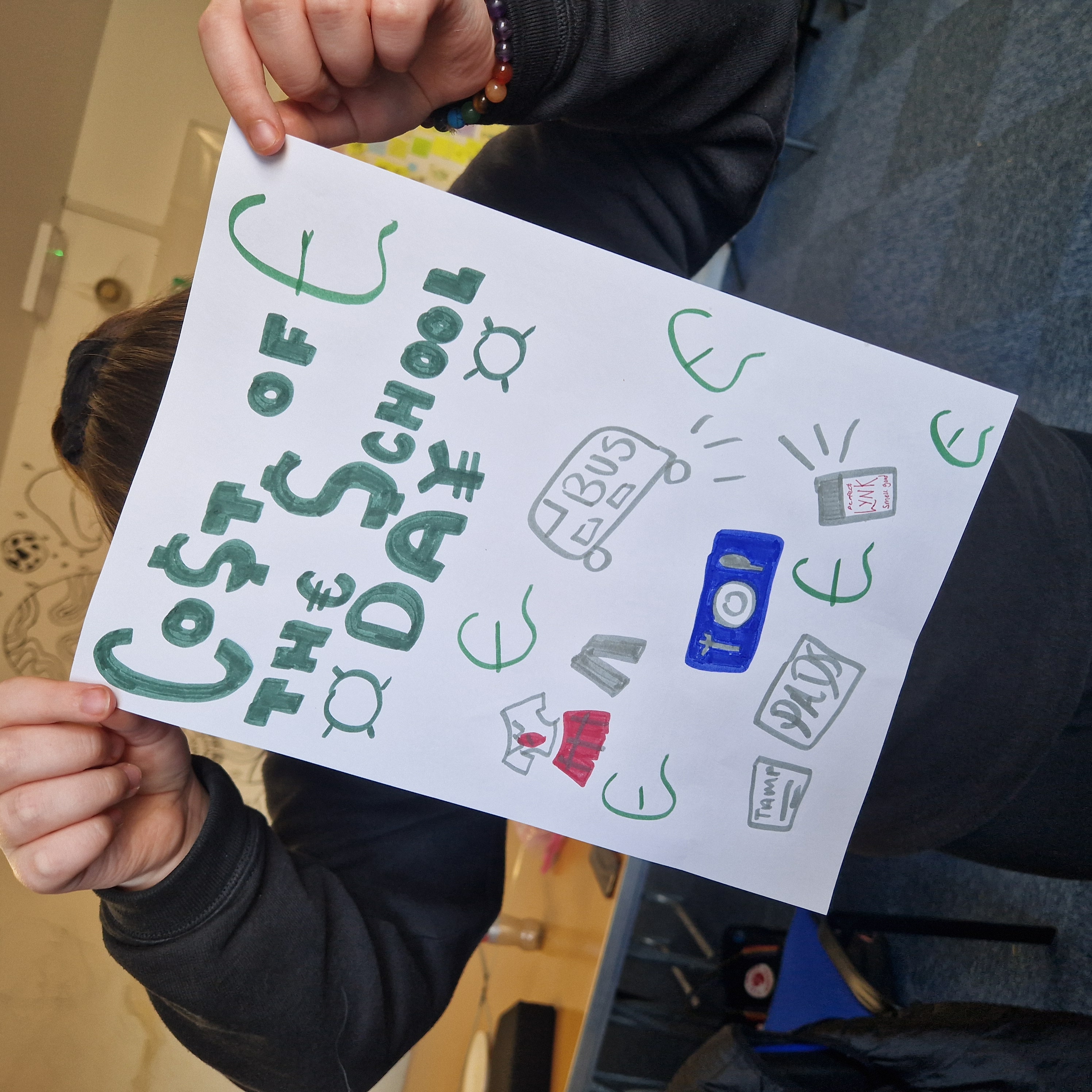
Young people raised concerns about the cost of the school day and how this affected them and their peers. They wanted to better understand shared challenges across Aberdeenshire and explore realistic ways to reduce costs within schools.
What did we hear?
Young people shared that:
- The cost of the school day can be a high for some pupils.
- Similar issues were being experienced by young people in different areas.
- Small, practical changes within schools could make a real difference.
They showed confidence, motivation and a strong sense of ownership over the ideas and solutions they developed.
What did we do with the voices we heard?
Young people took their ideas forward by:
- Discussing solutions within their youth groups.
- Inviting decision makers to focus group discussions.
- Speaking directly with teachers and school staff to help make positive changes happen.
This supported young people to influence decisions and contribute to reducing the cost of the school day in meaningful, achievable ways.
For more information about this work, contact:
Rachel Lewis, Youth Engagement Worker
Email: Rachel.Lewis@aberdeenshire.gov.uk -
Aberdeenshire Youth Forum (AYF) - Priority Setting and Exploration
Share Aberdeenshire Youth Forum (AYF) - Priority Setting and Exploration on Facebook Share Aberdeenshire Youth Forum (AYF) - Priority Setting and Exploration on Twitter Share Aberdeenshire Youth Forum (AYF) - Priority Setting and Exploration on Linkedin Email Aberdeenshire Youth Forum (AYF) - Priority Setting and Exploration link

Whose voice did we hear?
28 young people aged between 12-19 years from across Aberdeenshire gathered together on 29th March 2025
Why were we asking about this?
To identify and explore common issues and aspirations for young people, to support collaboration across youth groups and networks to address issues and to realise aspirations.
What did we hear?
Continue readingWhose voice did we hear?
28 young people aged between 12-19 years from across Aberdeenshire gathered together on 29th March 2025
Why were we asking about this?
To identify and explore common issues and aspirations for young people, to support collaboration across youth groups and networks to address issues and to realise aspirations.
What did we hear?
The following 5 priorities for young people were identified to support collective action and shared focus moving forward.
- Accessibility, disability inclusivity and representation
- Education services; local capacity impacting opportunities (subjects and support)
- Outdoor environment improvements and access – spaces for young people
- Transport and walking routes – including ‘safe’ walking routes.
- Rural enterprise and employment opportunities
What did we do with the voices we heard?
Young people signed up to take further action in different ways as AYF members which include subscribing to the free Aberdeenshire Youth Forum Bulletin on the Aberdeenshire Youth Forums Engage Page, signing up to AYF Thematic Groups that matter most to them to explore and progress common issues and aspirations identified on the day and signing up to the Aberdeenshire Youth Voice Promotion Group where young people support and lead on the AYF bulletin and communications.
For more information about this work, contact:
Roisin Daly, Senior Community Learning & Development Worker
-
Children & Young People's Services Plan 2026-29 Consultation
Share Children & Young People's Services Plan 2026-29 Consultation on Facebook Share Children & Young People's Services Plan 2026-29 Consultation on Twitter Share Children & Young People's Services Plan 2026-29 Consultation on Linkedin Email Children & Young People's Services Plan 2026-29 Consultation link
Whose voice did we hear?
275 children and young people, 114 parents & carers and 137 members of the multi agency workforce across Aberdeenshire.
Why were we asking about this?
To inform the development of Aberdeenshire’s Children and Young People’s Services Plan 2026–29. It helped us understand what matters most to children, young people and families and to shape shared priorities and commitments to improve wellbeing outcomes.
What did we hear?
A very wide variety of responses regarding how well Aberdeenshire's past priorities have been met and what children, young people, their families and the workforce feel needs to beContinue reading
Whose voice did we hear?
275 children and young people, 114 parents & carers and 137 members of the multi agency workforce across Aberdeenshire.
Why were we asking about this?
To inform the development of Aberdeenshire’s Children and Young People’s Services Plan 2026–29. It helped us understand what matters most to children, young people and families and to shape shared priorities and commitments to improve wellbeing outcomes.
What did we hear?
A very wide variety of responses regarding how well Aberdeenshire's past priorities have been met and what children, young people, their families and the workforce feel needs to be focused on for 2026-2029.
What did we do with the voices we heard?
What we heard has directly influenced our decisions regarding the focus for 2026-2029. This can be seen in the published plan (LINK).
For more information about this work, contact:
Nicola Kenyon, Strategic Development Officer (GIRFEC)
nicola.kenyon@aberdeenshire.gov.uk
-
Young People with Care Experience - Moving on from care 2025
Share Young People with Care Experience - Moving on from care 2025 on Facebook Share Young People with Care Experience - Moving on from care 2025 on Twitter Share Young People with Care Experience - Moving on from care 2025 on Linkedin Email Young People with Care Experience - Moving on from care 2025 link
Whose voice did we hear?
25 young people from across Aberdeenshire with experience of care, who are either close to moving on to independence or who were already living independently.
Why were we asking about this?
To help inform a proposal for a service to support young people moving on from care.
What did we hear?
A variety of viewpoints regarding experiences of moving on and what needs to be done better to support our young people.
What did we do with the voices we heard?
The views of young people directly influenced the proposal for a new service calledContinue reading
Whose voice did we hear?
25 young people from across Aberdeenshire with experience of care, who are either close to moving on to independence or who were already living independently.
Why were we asking about this?
To help inform a proposal for a service to support young people moving on from care.
What did we hear?
A variety of viewpoints regarding experiences of moving on and what needs to be done better to support our young people.
What did we do with the voices we heard?
The views of young people directly influenced the proposal for a new service called "The Hame Project". All aspects of the project, including the name were shaped by what was heard.
For more information about this work, contact:
Michelle Podlesny, Service Development Officer (The Promise), michelle.podlesny@aberdeenshire.gov.uk
Who's Listening
-
Service Development Officer (The Promise)
MP -
Strategic Development Officer (GIRFEC)
NK -
Senior CLD Worker
RD